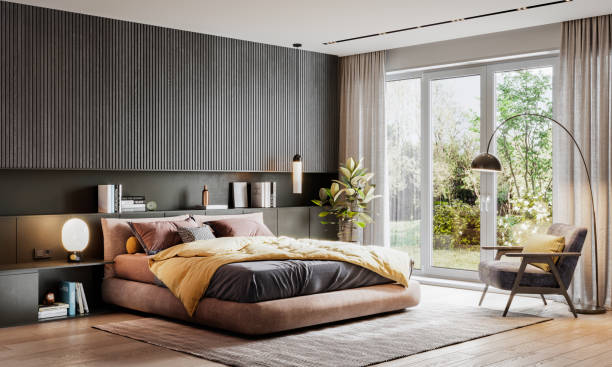
I remember the first time I truly understood the difference between “passing out” and “sleeping.” For years, I treated my bedroom like a secondary living room. I answered emails in bed, scrolled through social media until my eyes burned, and left a mountain of laundry on the chair in the corner. I was technically in bed for eight hours, but I woke up every morning feeling like I’d just finished a 12-hour shift.
It wasn’t until I decided to treat my bedroom like a professional performance space—where the “performance” was recovery—that everything changed.
We often think of sleep as a passive state, something that just happens when we’re tired enough. But deep, restorative sleep is actually an active biological process that requires a specific set of environmental triggers. If your room is too bright, too loud, or too cluttered, your brain stays in a state of “low-level alert,” preventing you from hitting those crucial REM and deep-sleep cycles.
If you’re ready to stop waking up tired, here is your professional blueprint for designing a bedroom that acts as a sanctuary for your nervous system.
1. The “Cave” Principle: Light and Temperature
The most basic biological requirement for sleep is a signal to your brain that the sun has gone down. Evolution has hard-wired us to sleep in cool, dark environments. When you fight this, you fight your own chemistry.
-
Total Blackout: Your skin has photoreceptors that can detect even small amounts of light. If there is a streetlamp glowing through your curtains or a blinking LED on your humidifier, your melatonin production can be suppressed. Invest in high-quality blackout curtains and use “dim-it” stickers to cover every electronic light in the room.
-
The Magic Number: Most sleep scientists agree that the ideal temperature for deep sleep is around 18°C (64°F). Your core body temperature needs to drop by a couple of degrees to initiate sleep. If your room is too warm, your heart rate stays elevated, and you’ll find yourself tossing and turning.
-
The “Warm Feet” Paradox: While the room should be cool, your extremities should be warm. Cold feet can keep you awake by preventing the dilation of blood vessels. A pair of soft socks or a warm hot water bottle at the foot of the bed can actually help you fall asleep faster.
2. The Mattress Architecture
We spend a third of our lives on a mattress, yet many of us treat it like an afterthought. If your mattress is more than seven or eight years old, it’s likely no longer providing the spinal alignment you need.
-
Support vs. Comfort: You want a mattress that keeps your spine in a neutral, straight line. If you wake up with lower back pain, your mattress is likely too soft. If you wake up with shoulder or hip pain, it’s likely too firm.
-
Breathability: Many modern “memory foam” mattresses trap body heat. This is the enemy of the cool-down process we discussed earlier. Look for mattresses with “gel-cooling” layers or, better yet, natural materials like wool or latex that allow for air circulation.
3. The “No-Fly Zone”: Technology and Blue Light
This is the hardest rule for most of us to follow, but it is the most impactful. Your bedroom should be a “tech-free” sanctuary.
-
The Blue Light Myth: It’s not just about the blue light hitting your eyes; it’s about the cognitive stimulation. Every time you check a notification, your brain releases a hit of dopamine or cortisol. That is the exact opposite of what you want before bed.
-
The Charging Station: Move your phone charger to the kitchen or the living room. If you use your phone as an alarm, buy a dedicated, “dumb” alarm clock. Removing the temptation to “just check one more thing” at 11:00 PM will do more for your sleep quality than any expensive pillow.
4. Aromatherapy and the “Olfactory Anchor”
Our sense of smell is directly linked to the emotional center of the brain. You can use this to “train” your body to fall asleep.
-
The Scent Strategy: Use a specific scent—like lavender, cedarwood, or bergamot—exclusively at bedtime. Whether it’s a linen spray or an essential oil diffuser, your brain will eventually associate that specific smell with sleep. This is called an “olfactory anchor.” After a few weeks, simply smelling that scent will trigger a relaxation response in your nervous system.
The Sleep Sanctuary Checklist
| Element | The “Sleep-Wrecker” | The “Deep-Sleep” Upgrade |
| Windows | Thin blinds; streetlamp glare. | Blackout drapes with side-seals. |
| Bedding | Synthetic polyester sheets. | 100% Cotton, Linen, or Bamboo. |
| Flooring | Cold, hard surfaces. | A soft rug to ground the space. |
| Wall Color | Bright red, yellow, or white. | Muted “Earth” tones (Sage, Navy, Sand). |
| Air Quality | Stagnant, dry air. | HEPA filter and 40-50% humidity. |
5. Visual Decompression: Managing the Clutter
Your eyes are constantly scanning your environment for threats or tasks. If your bedroom is filled with stacks of paperwork, a half-finished project, or a pile of laundry, your brain sees “to-do” lists, not “rest.”
-
Out of Sight, Out of Mind: If you must keep things in your bedroom, use “closed storage.” Put the laundry in a hamper with a lid. Put your books inside a drawer rather than on top of the nightstand.
-
The Minimalist Aesthetic: A healthy bedroom should feel “light.” Choose furniture with clean lines and avoid over-decorating. You want your eyes to be able to sweep across the room without getting “stuck” on any specific object.
6. Sound scaping: Blocking the World
Even when we are asleep, our ears are listening. A car alarm three blocks away or a creaking floorboard can pull you out of deep sleep even if you don’t fully wake up.
-
White Noise vs. Pink Noise: A white noise machine or a dedicated fan provides a consistent “curtain” of sound that masks sudden noises. Some people find “Pink Noise”—which sounds more like falling rain or rustling leaves—to be even more soothing for deep sleep cycles.
-
Soft Surfaces: If your room echoes, it will feel cold and alert. Adding “soft” elements like a thick rug, upholstered headboard, or wall tapestries helps absorb sound and creates an acoustically “dead” space that feels much more protective.
7. The Power of “Natural” Fabrics
In a world of high-tech synthetics, your bed is the place to go “old school.”
-
The “Plastic” Problem: Polyester and microfiber are essentially plastic. They don’t breathe, they trap sweat, and they can cause your body temperature to spike in the middle of the night.
-
The Cotton/Linen Advantage: Natural fibers are “thermoregulating.” They pull moisture away from your body and allow heat to escape. If you find yourself waking up “clammy,” the first thing you should change is your sheets.
Final Thoughts: The “Wind-Down” Ritual
You can have the most perfectly designed bedroom in the world, but if you jump into bed at 100 miles per hour, you’re still going to struggle. The bedroom is the destination, but the ritual is the journey.
Give yourself 30 minutes of “dim-light” time before you enter the bedroom. Dim the lights in the rest of the house, put away the screens, and let your eyes adjust to the darkness. When you finally step into your sleep sanctuary, your body should already be halfway to dreamland.
Designing a bedroom for sleep isn’t a luxury; it’s a fundamental investment in your health, your mood, and your longevity. You wouldn’t try to run a marathon in flip-flops—so don’t try to run your life on poor-quality sleep.
Leave a Reply