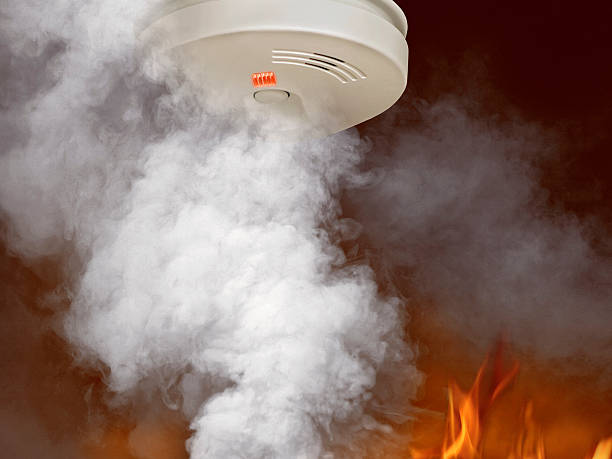
Let’s be honest: most of us only think about our smoke detectors when they start that high-pitched “chirp” at 3:00 AM because the battery is dying. It’s the universal sound of a homeowner losing their mind.
But if you live in a house with stairs, a basement, and multiple bedrooms, the “one and done” approach to smoke alarms is a dangerous gamble. Smoke is sneaky. It doesn’t just fill a room; it travels through the paths of least resistance—hallways, stairwells, and gaps in flooring. If your only alarm is in the kitchen, and a fire starts in the basement while you’re asleep on the third floor, you’re losing precious minutes of reaction time.
If you’ve recently moved or realized your current setup is a bit thin, here is how to map out your house like a pro, without spending a fortune.
The Golden Rule: One per Level (Minimum)
This is the baseline. If you have a basement, a main floor, and an upstairs, you need at least one alarm on every single floor.
Think of your house as a series of zones. If a fire starts in the basement (where the furnace and water heater live), the smoke has to travel up the stairs and through a door before it ever hits your main floor alarm. By the time that main floor alarm goes off, the basement is already a lost cause. You want the alarm as close to the source as possible.
The Bedroom Strategy: Inside and Out
In a multi-storey home, the bedrooms are usually clustered together on the upper floors. This is where most people get it wrong. They put one alarm in the hallway and think they’re covered.
Here’s the thing: modern homes are full of synthetic materials (think IKEA furniture and polyester rugs) that burn fast and hot. If you sleep with your bedroom door closed—which you should, as it acts as a fire barrier—you might not hear a hallway alarm until the smoke is already thick.
The Strategy:
-
One inside every bedroom.
-
One in the hallway immediately outside the sleeping area.
It feels like overkill until you realize that if a phone charger sparks a fire inside your guest room, you want to know about it before the smoke reaches the hallway.
The Stairwell “Chimney” Effect
In a house with multiple floors, the stairwell acts like a chimney. Smoke is hot; it rises. If a fire starts on the ground floor, that smoke is going to race up the stairs.
The best place for a detector in a stairwell is at the very top. If you put it halfway down the stairs, the smoke might bypass it as it clings to the ceiling of the upper landing. Placing it at the highest point ensures that as the smoke “pools” against the ceiling, it hits the sensor immediately.
The Kitchen “False Alarm” Buffer
We’ve all done it. You sear a steak or burn some toast, and suddenly the alarm is screaming. This leads to the most dangerous habit in home ownership: taking the batteries out “just for a second” and forgetting to put them back.
To avoid this, don’t put your detector in the kitchen. Put it about 10 to 15 feet away. You want it close enough to catch a real kitchen fire, but far enough away that a little bit of bacon grease doesn’t trigger a neighborhood-wide alert. If you’re worried about the kitchen specifically, look for a “Heat Alarm” instead of a smoke alarm. They trigger based on temperature spikes, not burnt toast.
The “Dead Air” Trap
Physics matters here. When smoke rises, it hits the ceiling and then spreads out. However, smoke rarely makes it into the sharp corners where the wall meets the ceiling. This is called “dead air” space.
If you mount your detector right in the corner, the smoke might literally flow right around it. The sweet spot is at least 4 inches away from any corner. If you’re mounting it on a wall (though the ceiling is always better), keep it between 4 and 12 inches down from the ceiling.
Interconnected Alarms: The Real Game-Changer
If you really want to do this right—especially in a big house—get interconnected alarms.
In the old days, this required a contractor to rip open your walls to run wires. Now, you can buy “wireless interconnect” alarms for about $30–$40 each. They talk to each other over a radio frequency.
This is the gold standard for multi-storey living. If a sensor in the basement detects smoke, every alarm in the house goes off. You get alerted in your third-floor bedroom the second there’s trouble three floors below you. It removes the “I didn’t hear it” factor entirely.
Don’t Forget the Basement
The basement is the “engine room” of the house. It’s where the electrical panel, the dryer, and the HVAC system live. It’s also usually the place we visit the least.
Mount your basement alarm on the ceiling at the bottom of the stairs. This ensures that if smoke starts heading for the rest of the house, the alarm catches it at the “exit” of the basement.
The Bottom Line
You don’t need to be a fire marshal to get this right. Just follow the “Path of the Smoke.” Start in the basement, hit every bedroom, and make sure the top of the stairs is covered.
Spend an afternoon doing this, and then—the most important part—mark your calendar to test them once a month. It takes two minutes, and it’s the only way to make sure your “cheap” security system is actually standing guard.
Leave a Reply