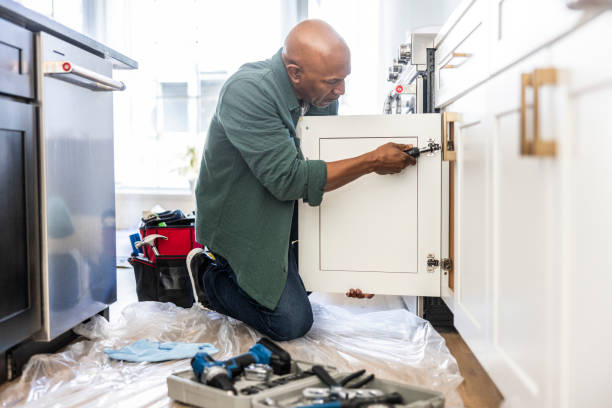
I will never forget the first time I had to call a professional for a home repair. It was a few months after I moved into my first place, and the garbage disposal had suddenly stopped working. It just emitted a menacing, low hum every time I flipped the switch. Terrified of breaking the plumbing, I called a local handyman.
He arrived, walked into the kitchen, reached under the sink with a small metal tool, gave it a quick twist, and flipped the switch. The disposal roared back to life perfectly. The entire process took exactly forty-five seconds.
Then, he handed me an invoice for a $125 “service call fee.”
I wasn’t mad at him; he was running a business, and his time was valuable. I was mad at myself. I had just paid a premium price for a lack of basic knowledge. That $125 invoice was the catalyst that changed how I approach homeownership. I realized that the vast majority of the “contractor tax” we pay isn’t for highly specialized skills; it is simply the cost of getting a professional to drive to your house.
When you learn to tackle the foundational, everyday repairs yourself, you aren’t just fixing a sink or a wall. You are reclaiming your financial independence. You are keeping hundreds of dollars in your bank account where they belong.
Here is the professional, homeowner-to-homeowner guide to the most common DIY home repairs that will save you massive contractor fees, zero specialized training required.
1. The Jammed Garbage Disposal (The $125 Fix)
Let’s start with the exact issue that cost me so much money years ago. When a garbage disposal hums but won’t spin, the motor isn’t dead; the grinding plates are simply jammed by a rogue piece of bone, a fruit pit, or even a piece of silverware.
-
The Professional Fix: Look underneath the disposal unit under your sink. Right in the dead center of the bottom, there is a small hexagonal hole.
-
The Tool: Take a standard 1/4-inch Allen wrench (also called a hex key), insert it into that hole, and crank it back and forth. You will feel resistance, and then it will suddenly break free and spin smoothly.
-
The Reset: Before turning it back on, push the small red “Reset” button located on the bottom or side of the unit. Turn on the water, flip the switch, and you just saved yourself a minimum $100 service call.
2. The Running Toilet (The Silent Budget Killer)
A toilet that constantly runs is doing two things: keeping you awake at night and secretly adding $20 to $50 a month to your water bill. If you call a plumber, you will pay a minimum $150 call-out fee to have them do a job that takes five minutes.
-
The Culprit: 95% of the time, the issue is a warped or degraded “flapper”—the rubber seal at the bottom of the toilet tank that lifts when you flush.
-
The Professional Fix: Go to any hardware store and buy a universal toilet flapper for about $8. Turn off the water valve behind the toilet. Flush the toilet to drain the tank. Reach in, unclip the old rubber flapper from the plastic pegs, and unhook its chain. Clip the new one on, attach the chain with a little bit of slack, and turn the water back on.
3. Patching Drywall (The Handyman Special)
Whether a doorknob slammed into the wall too hard or you removed a television mount that left massive anchor holes, damaged drywall is an eyesore. A handyman will often charge a half-day minimum (around $200) to patch, mud, and sand a hole.
-
The Professional Fix: For holes smaller than a fist, buy a $15 “drywall patch kit” that includes an aluminum mesh patch, a small tub of joint compound (spackle), and a plastic putty knife.
-
The Method: Stick the self-adhesive mesh patch over the hole. Use the putty knife to spread a thin layer of the compound over the mesh, feathering the edges out so it blends with the wall. Let it dry, sand it smooth with a sanding sponge, and apply one more paper-thin coat. Once painted, no one will ever know it was there.
The ROI of DIY: Cost Comparison
| Repair | Average Contractor Fee | DIY Cost (Parts) | Money Saved |
| Garbage Disposal Jam | $125 – $150 | $0 (If you own an Allen wrench) | $150 |
| Toilet Flapper Replacement | $150 – $200 | $8.00 | $142 |
| Drywall Patch (Small) | $150 – $250 | $15.00 | $135 |
| Light Switch Replacement | $150 – $200 | $5.00 | $145 |
| Re-caulking a Shower | $200 – $300 | $12.00 | $188 |
4. Replacing a Light Switch or Outlet (Safety First)
Electrical work terrifies most homeowners, which is exactly why electricians can charge $150 just to pull into your driveway. While you should absolutely hire a professional for major panel upgrades or rewiring a room, replacing a loose outlet or a cracked light switch is a beginner-level task.
-
The Golden Rule: Go to your breaker box and flip the switch for that specific room to “OFF.” Then, plug a lamp into the outlet (or flip the light switch) to visually confirm the power is dead. Buy a $15 non-contact voltage tester pen for extra peace of mind.
-
The Professional Fix: Unscrew the faceplate. Unscrew the two screws holding the switch or outlet to the box and pull it out gently. You will usually see three wires: a black wire (hot), a white wire (neutral), and a bare copper wire (ground).
-
Simply unscrew the wires from the old unit, and attach them to the exact same spots on the new $3 unit. Wrap the bare wire around the green ground screw, the white wire around the silver screw, and the black wire around the brass screw. Screw it back into the wall, flip the breaker back on, and you’re done.
5. Re-Caulking a Bathtub or Shower
If the line of caulk where your bathtub meets the tile is turning black, cracking, or peeling, you have a ticking time bomb. Water will seep behind that crack, rot the drywall, and create structural mold. Paying a contractor to strip and re-caulk a tub can cost over $200.
-
The Professional Fix: Buy a $6 tube of 100% Silicone Kitchen & Bath Caulk and a $5 caulk removal tool.
-
The Method: The secret to a professional job is preparation. Scrape away every trace of the old caulk. Wipe the area down with rubbing alcohol to remove soap scum and let it dry completely. Apply a steady, even bead of new silicone along the seam. Wet your finger with a little bit of soapy water and glide it lightly over the bead to smooth it into a perfect, watertight seal.
6. Cleaning Refrigerator Coils (The Appliance Saver)
When a refrigerator stops cooling efficiently, most people assume the compressor is dead and call an appliance repair tech. The tech comes out, charges $150, and spends ten minutes vacuuming the back of the fridge.
Your refrigerator breathes through a series of coils (usually located behind a kickplate at the bottom front, or on the very back of the unit). If those coils are choked with pet hair and dust, the fridge cannot release heat, forcing the motor to run constantly until it burns out.
-
The Professional Fix: Unplug the fridge. Remove the kickplate or pull the unit away from the wall. Buy a $10 “coil cleaning brush” (it looks like a giant pipe cleaner) and gently scrub the dust off the coils while holding your vacuum hose right next to the brush to suck up the debris. Doing this twice a year extends the life of a $2,000 appliance by a decade.
Final Thoughts: Building the Muscle of Confidence
The financial savings of DIY home repair are undeniable. If you tackle just three of the items on this list this year, you will have saved yourself nearly $500. That is real money that can be redirected toward your investments, an emergency fund, or a family vacation.
But the true value of picking up a screwdriver goes far beyond the money. It is about the psychological shift from feeling helpless to feeling capable. It is the deep, quiet pride you feel when you wash your hands, look at a perfectly patched wall or a smoothly running sink, and know that you fixed it.
Your house is your biggest financial asset. It is time to stop being intimidated by it, and start managing it like the professional homeowner you are.
Take Action Today
We all have that one household task that we’ve been putting off because it feels just slightly above our skill level.
What is the one home repair you are most intimidated to try yourself? Drop it in the comments below, and let’s break it down into simple, manageable steps so you can get it done this weekend!
Leave a Reply