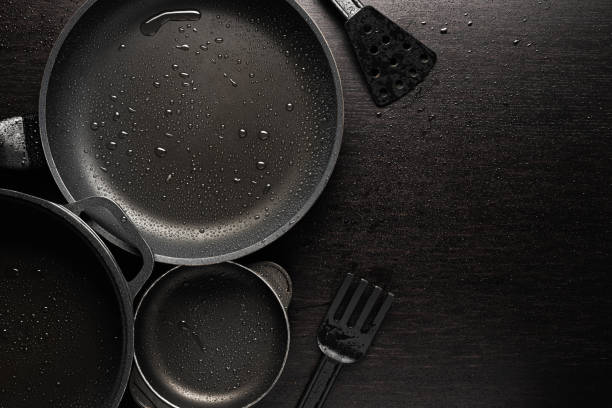
I will never forget the morning I realized I was eating my own frying pan. I was making scrambled eggs, a daily ritual, and as I slid them onto my plate, I noticed tiny, black specks mixed in with the yellow. At first, I thought it was pepper. Then I looked at my favorite, trusty non-stick skillet and saw the reality: the coating was flaking off.
For years, I had focused intensely on what I was eating. I bought organic produce, read nutrition labels like a detective, and cut back on processed sugars. But it had never crossed my mind to investigate the surface I was cooking that food on.
The truth is, the cookware industry has a long history of prioritizing convenience over health. The promise of “easy cleanup” led to the mass production of chemical coatings that, over time, end up in our food, our water, and our bodies. If you are putting effort into cooking healthy meals for yourself and your family, the last thing you want is for your pots and pans to introduce invisible toxins into the mix.
Upgrading to non-toxic cookware doesn’t mean you have to sacrifice convenience or spend a fortune. It just requires a professional understanding of material science. Here is your definitive guide to what you should purge from your cabinets, and the lifetime pieces you should replace them with.
The Culprits: What to Avoid
When we talk about “toxic” cookware, we are generally referring to materials that leach chemicals or heavy metals into your food when exposed to heat, acid, or physical scratching.
1. Traditional Non-Stick (PTFE/Teflon)
This is the big one. For decades, Teflon was the undisputed king of the kitchen. The magic behind that frictionless surface is a synthetic polymer called Polytetrafluoroethylene (PTFE).
The problem? To manufacture PTFE, companies historically used PFOA (Perfluorooctanoic acid), a “forever chemical” that has been linked to severe health issues, including thyroid disorders and certain cancers. While PFOA was largely phased out in 2013, the replacement chemicals (often grouped under the PFAS family) are showing similar concerning traits.
Furthermore, when a PTFE-coated pan is heated above 500°F—which happens in just a few minutes on a gas stove—the coating begins to break down and release toxic fumes. This can cause a temporary condition literally known in the medical community as “polymer fume fever.” If it can kill a pet bird in the same room (which it is famous for doing), you probably shouldn’t be searing your steak on it.
2. Uncoated Aluminum
Walk into a restaurant supply store, and you will see stacks of cheap, lightweight aluminum pans. Aluminum is an incredible conductor of heat, which makes it great for cooking.
However, uncoated aluminum is highly reactive. If you cook acidic foods—like tomato sauce, vinegar reductions, or lemon-heavy dishes—in an uncoated aluminum pan, the metal can leach into your food. While the occasional exposure isn’t going to cause immediate harm, chronic exposure to dietary aluminum is something most health professionals advise minimizing.
3. The “Greenwashed” Ceramic Conundrum
In response to the anti-Teflon movement, the market was flooded with “green” and “pure” ceramic-coated pans. They look beautiful on social media, often arriving in pastel colors.
Here is the professional secret: most of these are not solid ceramic. They are aluminum pans sprayed with a thin “sol-gel” coating (a silicone-like derivative). While they are generally free of PFAS and safer than Teflon, the coating degrades incredibly fast. Within six to eight months of regular use, they lose their non-stick properties, everything sticks to them, and they end up in a landfill. They aren’t highly toxic, but they are a terrible financial investment.
The Safe Swaps: What to Buy Instead
The good news is that the safest cookware materials are also the most durable. The professional kitchens of the world don’t use delicate chemical coatings; they use materials that can take a beating and last for generations.
1. The Workhorse: Cast Iron
If you only make one swap today, buy a heavy, classic cast iron skillet.
-
The Benefits: Cast iron is completely chemical-free. In fact, cooking in it can actually leach trace amounts of dietary iron into your food, which is a benefit for many people. It holds heat beautifully, making it perfect for searing meats and baking cornbread.
-
The Myth: People are terrified of “seasoning” cast iron. It’s not a fragile artifact. Seasoning is just oil that has been baked into the metal (polymerization) to create a natural, non-stick surface. Wash it with a little soap, dry it thoroughly on the stove, wipe it with a drop of oil, and it will outlive you.
2. The Chef’s Secret: Carbon Steel
If cast iron is too heavy for your wrists, carbon steel is your answer. It is the material used for traditional woks and French crepe pans.
-
The Benefits: It has the exact same non-toxic profile and seasoning process as cast iron, but it is stamped from a thinner sheet of metal. This makes it significantly lighter and much more responsive to temperature changes. It becomes incredibly non-stick over time; you can easily fry an egg on a well-seasoned carbon steel pan.
3. The Everyday Essential: Tri-Ply Stainless Steel
You cannot cook acidic foods like tomato sauce in cast iron or carbon steel (the acid strips the natural seasoning). For boiling pasta, making soups, and sautéing vegetables, stainless steel is the professional standard.
-
The Benefits: It is non-reactive, non-toxic, and virtually indestructible. Look for “Tri-Ply” or “Clad” stainless steel. This means there is a core of aluminum sandwiched between two layers of stainless steel. You get the safety of steel with the heat conductivity of aluminum.
-
The Trick: To keep food from sticking to stainless steel, you must preheat the pan before adding oil. Use the “water drop test.” Flick a drop of water into the dry, heating pan. If it sizzles and evaporates, it’s not ready. If it forms a perfect bead and glides across the surface like mercury (the Leidenfrost effect), your pan is ready for oil and food.
4. The Heirloom: Enameled Cast Iron
Think of a classic Le Creuset or Staub Dutch oven. This is cast iron that has been coated with a baked glass particulate (enamel).
-
The Benefits: It requires absolutely no seasoning, won’t rust, and is completely inert, meaning it won’t react with acidic foods. It is the absolute best vessel for braising meats, making stews, or baking sourdough bread. They are expensive, but they are lifetime pieces.
The Cookware Transition Cheat Sheet
| Material | Toxicity Risk | Best Used For | Maintenance Level |
| Teflon/PTFE | High (Chemical leaching) | Nothing. Time to toss. | Low |
| Cast Iron | Zero | Searing, baking, frying. | Medium (Keep it dry and oiled) |
| Carbon Steel | Zero | Eggs, stir-fry, quick sautés. | Medium (Keep it dry and oiled) |
| Stainless Steel | Zero | Sauces, boiling, acidic foods. | Low (Dishwasher safe) |
| Enameled Iron | Zero | Braising, soups, stews. | Low (Easy to wash, no seasoning) |
Final Thoughts: The “One-In, One-Out” Strategy
When you realize what is lurking in your non-stick pans, the instinct is to grab a trash bag, empty your cabinets, and drop $800 on a brand new, gleaming stainless steel set.
Don’t do that.
Transitioning your kitchen shouldn’t be a financial crisis. Approach it with the professional “One-In, One-Out” method. Identify the pan you use the most—usually the 10-inch or 12-inch frying pan. Throw that single Teflon pan away today, and replace it with one high-quality carbon steel or cast iron skillet.
Learn how to use it. Learn how to wash it. Once you feel comfortable, move on to replacing your saucepans with stainless steel.
Cooking is one of the most intimate things we do. We are taking raw ingredients, applying heat, and putting them inside our bodies to build our cells. By upgrading your cookware, you are removing the chemical middleman and ensuring that the only thing on your plate is the food you actually intended to cook.
Take Action Today
Go into your kitchen and look closely at your most-used non-stick pan. Are there scratches? Is the silver metal shining through the black coating? If so, it’s time to retire it.
What is the one dish you cook the most often? Drop it in the comments below, and I’ll tell you exactly which non-toxic pan material is the perfect match for your cooking style!
Leave a Reply